
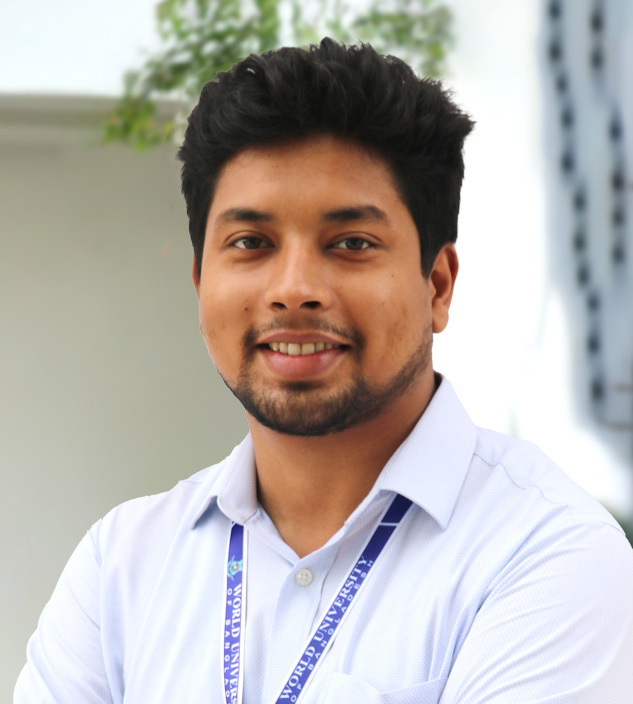
Anup Kumar Mitra
BA GSTU, MA GSTU
Lecturer, Department of English
https://orcid.org/0009-0000-3029-9371Personal profile
Biography
Anup Kumar Mitra is a Bangladeshi academic, researcher, and educator
specializing in English literature, cultural studies, ecocriticism,
postcolonial studies, environmental humanities, critical animal studies,
critical plant humanities, film and media studies, and critical-affective
pedagogy. He currently serves as a Lecturer in the Department of English at
the World University of Bangladesh (WUB), Dhaka, where he began his
academic career in July 2026.
His academic and research interests are strongly interdisciplinary, connecting
literature and culture with environmental concerns, questions of human and
non-human relationships, decolonization, pedagogy, media, artificial
intelligence, and contemporary social issues. His developing body of
scholarship reflects a particular commitment to examining literary and cultural
texts from postcolonial, ecological, posthuman, and interdisciplinary
perspectives.
Education
Mitra
completed both his undergraduate and postgraduate education in English at Gopalganj
Science and Technology University, Bangladesh.
He
earned his Master of Arts in English Literature and Cultural Studies in
the 2022–23 academic session, achieving a CGPA of 3.77 and securing 2nd
position in the merit list. His MA thesis, titled “Global Screens, Local
Voices: Exploring Climate Change Representations in Selected Films and
Bangladeshi Audience Responses,” investigated climate change representation
in cinema alongside audience responses in Bangladesh. His postgraduate studies
included Postcolonial Studies, Comparative Literature, Literary Theory,
Cultural Studies, Contemporary British Literature, Shakespeare, Bangladeshi
Writing in English, and modern and postmodern literary studies.
Earlier,
he completed his Bachelor of Arts (Honors) in English, obtaining a CGPA
of 3.44 and ranking 3rd in his cohort. His undergraduate coursework
provided a broad foundation in research methodology, media studies, literary
criticism, South Asian literature, American literature, translation studies,
English language teaching, sociolinguistics, psycholinguistics, phonetics and
phonology, philosophy, and cultural anthropology.
His
academic performance was recognized with the Vice Chancellor Scholarship for
Academic Excellence in 2025 after he secured second position in the MA
program. He was also awarded the competitive GSTU Master of Arts (Thesis)
Fellowship by the university’s Research Center for the 2025–2026 fiscal
year to support full-time research and publication activities.
Academic
Career
Mitra
joined the Department of English at the World University of Bangladesh
as a Lecturer on 6 July 2026. His appointment marked the beginning of
his full-time university teaching career following several years of active
engagement in research, academic conferences, student organizations, cultural
activities, and scholarly publication.
As
an educator, his interests extend beyond conventional literary instruction to
interdisciplinary and student-centered approaches to English studies. His
research on critical-affective and humanising pedagogy, film-based learning,
decolonization, and artificial intelligence in language education reflects his
broader interest in connecting classroom teaching with emerging educational,
ethical, technological, and social concerns.
Research
Contributions
Mitra
has developed an expanding research portfolio covering postcolonial
literature, ecocriticism, environmental humanities, film and media studies,
critical animal studies, critical plant humanities, cultural studies,
decolonization, critical-affective pedagogy, ecofeminism, and TESOL.
His
published research includes studies of petrocapitalism and environmental crisis
in The Rime of the Ancient Mariner, anthropocentrism and posthuman
possibilities in Mohsin Hamid’s Exit West, identity and religion in
Daniel Defoe’s Robinson Crusoe, film as a tool for developing critical
thinking in arts education, and the relationship between postcolonialism, race,
gender, and Gothic fiction in Charlotte Brontë’s Jane Eyre.
His
continuing research further expands into critical animal studies, Shakespeare
and environmental crisis, critical plant studies, climate cinema of the Global
South, humanising pedagogy in TESOL, and ethical concerns surrounding
artificial intelligence and data privacy in language assessment.
A
defining feature of Mitra’s research is his effort to reconsider established
literary texts through contemporary theoretical perspectives. Rather than
treating canonical literature solely as historical or aesthetic material, his
work explores how literature can illuminate present-day questions involving
ecology, climate change, migration, coloniality, species relations, social
justice, education, technology, and cultural power.
Conference
Presentations and International Academic Engagement
Mitra
has been an active participant in national and international academic
conferences since his undergraduate and postgraduate years. He has presented
research at conferences organized by universities and academic organizations in
Bangladesh, India, and Nepal, addressing literature, language education,
environmental humanities, decolonization, artificial intelligence, pedagogy,
and cultural studies.
His
conference presentations have examined topics including ecological mourning in
Arundhati Roy’s The God of Small Things, AI literacy among
tertiary-level English students in Bangladesh, ecological crises in Shakespeare’s
As You Like It, film and critical thinking, critical plant studies,
speciesism and racism, and data privacy and ethical challenges associated with
AI in language assessment.
He
has also presented papers on decolonizing English curricula, linguistic
imperialism in the Global South, trans-speciesism and social justice, posthuman
approaches to migration and borders, contemplative pedagogy, and ecological
representations in literature. His participation has included conferences
organized by institutions and organizations such as the British Council,
BRAC University, North South University, University of Rajshahi, Independent
University Bangladesh, Green University of Bangladesh, Daffodil International
University, Tribhuvan University, and the University of Liberal Arts Bangladesh.
These
engagements reflect his growing interest in participating in interdisciplinary
academic conversations that extend beyond traditional literary studies and
connect humanities scholarship with environmental, technological, educational,
and social challenges.
Awards and
Academic Recognition
Mitra’s
early academic career has been marked by recognition for academic achievement
and research potential. His principal academic honors include the Vice
Chancellor Scholarship for Academic Excellence from Gopalganj Science and
Technology University and the GSTU Master of Arts (Thesis) Fellowship,
awarded on the basis of academic merit and intended to support research and
publication.
Securing
second place in his MA program and third place during his undergraduate studies
further demonstrates a consistent record of strong academic performance.
Professional
Development
Alongside
literary and cultural studies, Mitra has pursued professional development
across language, technology, research, communication, and digital skills.
He
completed the American Pronunciation of English training and
certification organized by Northern Arizona University, USA, in 2024. He
also completed a 60-hour Introduction to Programming with Python
training conducted by the Department of Computer Science and Engineering at
Gopalganj Science and Technology University.
His
additional training includes courses in digital marketing, WordPress and
WooCommerce, web development, UI/UX design, corporate and advanced English,
time management, emotional intelligence, mobile photography, freelancing, and
social media marketing.
He
is familiar with Microsoft Office, Google Workspace, SPSS, Python, HTML, CSS,
WordPress, WooCommerce, online communication platforms, and basic photo and
video editing.
Leadership, Service, and Cultural Engagement
Mitra’s
university experience has also been characterized by extensive involvement in
student leadership, volunteerism, cultural activities, and organizational
service. He has served in positions including Vice-President and Publicity
Secretary of the Rajbari District Student Association, Editorial Board
Member of Udici, Campus Ambassador, Departmental Delegate for the Hult Prize,
volunteer, and member of several university-based social, cultural, and
environmental organizations.
He
also worked as an editorial assistant and volunteer coordinator for the 1st
National Student Conference 2025 organized by the Department of English at
Gopalganj Science and Technology University. His responsibilities included
formatting and publishing the Book of Abstracts, coordinating volunteers,
managing registration records through Google Workspace, assisting with the
registration booth, and editing certificates.
Beyond
academic activities, Mitra has experience in theatre, music, public speaking,
and cultural performance. He has participated in performances and direction of
plays including Waiting for Godot, Volpone, and A Doll’s House,
and has performed as a vocalist and chorus singer in departmental cultural
programs.
His
sustained involvement in volunteering and community-oriented activities
reflects a broader commitment to collaborative learning, cultural engagement,
organizational responsibility, and service beyond the classroom.
Research and
Career Philosophy
Anup
Kumar Mitra’s emerging academic career is guided by a commitment to interdisciplinary
scholarship, environmental responsibility, decolonial thinking, inclusive
education, and continuous intellectual development.
His
research seeks to explore how literature, film, culture, and language education
can contribute to understanding some of the defining questions of contemporary
society—from climate change and ecological crisis to colonial legacies,
human-animal relationships, technological transformation, artificial
intelligence, and educational ethics.
As
an educator and researcher, he aims to bridge literary scholarship with
contemporary realities while encouraging students to approach texts critically,
ethically, and imaginatively. His long-term academic interests lie in
developing as a literary and cultural critic, strengthening interdisciplinary
research in the environmental humanities and postcolonial studies, contributing
to innovative approaches to English education, and participating in scholarly
collaborations within Bangladesh and the wider international academic
community.
Education/Academic Qualification
Research expertise keywords
Research output
2025
Supervised Work
Participations
2026
2025
2024
Project
Awards
2026
2025
Membership
Certifications
2024
Research Poster
